
World-Class Education at a Fraction of the Cost
When families across Central Asia consider international university education, the United States and the United Kingdom often dominate the conversation. Their universities enjoy extraordinary reputations, and their influence on global higher education is undeniable.
Yet one of the most frequently discussed questions in my university counselling work is also one of the most practical: What will this education actually cost?
Tuition fees, accommodation, living expenses and the possibility of additional preparatory study can turn an attractive university offer into a substantial financial commitment. For families making decisions that may shape their children's professional and personal futures, these considerations are far from secondary.
What is sometimes overlooked is that many of Europe's most respected universities operate within a very different financial framework. Across Continental Europe, longstanding traditions of public investment in higher education have helped preserve access to internationally recognised institutions at comparatively modest tuition fees.
For students willing to look beyond the most familiar destinations, the possibilities deserve serious attention.
1. Academic prestige does not have a uniform price
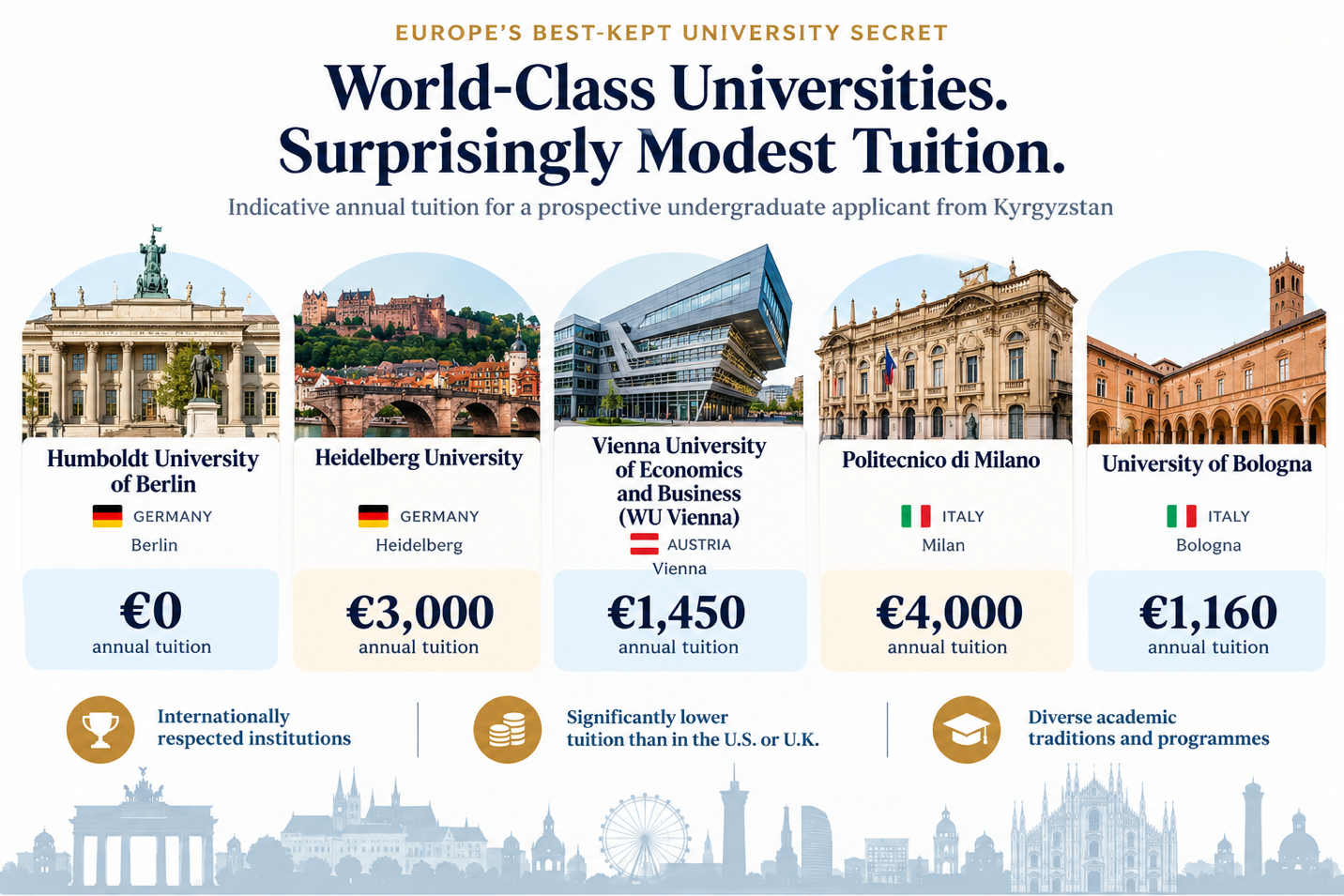
Consider Humboldt University of Berlin, Heidelberg University, Vienna University of Economics and Business (WU Vienna), Politecnico di Milano and the University of Bologna.
These institutions represent different academic traditions, from Germany's research universities and Austria's business education to Italy's historic universities and technical institutions. What they share is an international reputation that does not necessarily translate into the tuition fees associated with elite American or British universities.
For a prospective undergraduate applicant from Kyrgyzstan, the following indicative annual tuition figures illustrate the difference:
| University | Approx. annual tuition |
|---|---|
| Humboldt University of Berlin, Germany | €0 |
| Heidelberg University, Germany | €3,000 |
| WU Vienna, Austria | €1,450 |
| Politecnico di Milano, Italy | €4,000 |
| University of Bologna, Italy | €1,160 |
Figures are approximate annual tuition amounts for the reference applicant, excluding living expenses and routine administrative contributions. Bologna's estimate assumes eligibility for its published non-OECD-country fee arrangement.
The contrast with the tuition fees commonly associated with prestigious American and British universities is considerable.
The explanation is partly structural. Many Continental European universities receive substantial public funding and are not expected to finance their teaching activities primarily through international student tuition.
This does not mean admission is easy, that every programme is inexpensive, or that all degrees are available in English. It does mean that students should not assume an internationally respected university is automatically beyond their family's financial reach.
2. Studying in English: more opportunities than many families realise
The affordability of Continental European higher education is only useful to an international applicant if the academic programme is accessible.
Many of Europe's most established public universities still teach the majority of their undergraduate programmes in the national language. That remains true in important parts of Germany, Austria, France, Italy and Spain.
Nevertheless, the landscape has changed considerably. English-taught bachelor's programmes are now available across a range of disciplines, particularly Business, Economics, International Relations, Computing and selected Engineering fields.
A few examples illustrate the variety:
| University | English-taught bachelor's programme | Approx. annual tuition |
|---|---|---|
| WU Vienna, Austria | Business and Economics | €1,450 |
| University of Pavia, Italy | Artificial Intelligence | €390 |
| Masaryk University, Czechia | Business Management and Finance | €4,800 |
| Budapest University of Technology and Economics, Hungary | Chemical Engineering | €6,400 |
| University of Debrecen, Hungary | Business Administration and Management | US$7,000 |
| Maastricht University, Netherlands | European Studies | €13,200 |
Figures represent indicative annual tuition for a prospective undergraduate applicant from Kyrgyzstan. Actual fees and programme availability should be confirmed for the relevant academic year.
These programmes differ substantially in academic focus, selectivity, teaching methods and admission requirements. They should not be treated as interchangeable simply because they are delivered in English.
WU Vienna, for example, offers an English-taught Bachelor in Business and Economics with a formal selection procedure. The relatively modest tuition does not eliminate academic competition.
The Netherlands offers a particularly extensive English-language undergraduate environment, although international tuition is generally higher than at many German, Austrian or Italian public universities.
Germany presents a different picture: the public university sector remains comparatively affordable, but German-language proficiency is often essential for undergraduate admission.
For families planning early, this is an argument for broadening language education rather than relying exclusively on English.
In Central Asian schools, introducing German and Chinese from Grade 9 alongside English could significantly expand students' longer-term educational choices. German can open access to a substantial public university system, while Chinese can support opportunities within another major international higher education landscape.
Language preparation is therefore not merely an additional school subject. It can be an investment in future academic mobility.
3. Affordable private universities also deserve consideration
Public universities are not the only route into European higher education.
Across Continental Europe, private institutions offer English-taught undergraduate programmes, sometimes with more flexible admissions processes, smaller teaching environments or a stronger applied and professionally oriented focus.
Institutions worth examining include Central European University in Vienna, the University of New York in Prague, IPAG Business School in France, ESIC University in Spain and selected private universities in Germany.
Depending on the institution and programme, annual tuition may fall broadly within the €6,000–€15,000 range, although some programmes cost more.
Private universities should be evaluated carefully. Accreditation, degree-awarding authority, academic recognition, progression opportunities and graduate outcomes matter considerably more than promotional claims about international orientation.
Nevertheless, for students seeking English-language instruction and an alternative to the most selective public institutions, these universities can provide valuable additional choices.
4. Tuition is only part of the financial equation
Families rarely make university decisions on tuition alone. Accommodation, food, health insurance, transportation and personal expenses must also be considered.
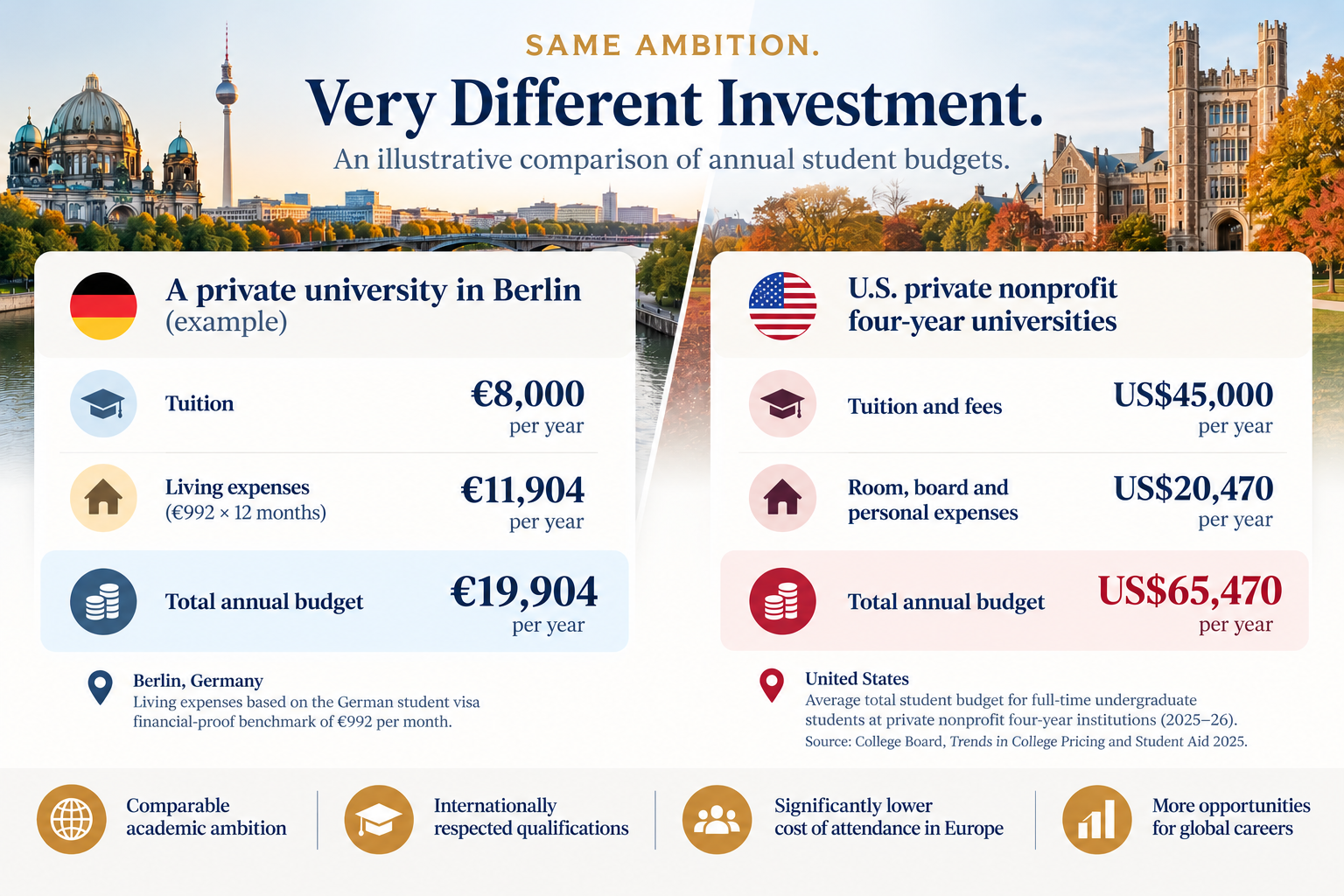
To illustrate the broader financial picture, imagine an international student attending an English-taught private university in Berlin with annual tuition of €8,000.
Using an illustrative monthly living budget of €992, the annual calculation would be:
| Annual expense | Estimated amount |
|---|---|
| Tuition at a private institution | €8,000 |
| Living expenses (€992 × 12) | €11,904 |
| Total annual budget | €19,904 |
The monthly living allowance of €992 corresponds to the commonly used German student visa financial-proof benchmark. It is a useful planning reference, although actual expenditure in Berlin may be higher, particularly for accommodation.
For comparison, the College Board's Trends in College Pricing and Student Aid 2025 estimates the average annual student budget at $65,470 for full-time undergraduate students attending private nonprofit four-year institutions in the United States in 2025–26.
The two examples are not identical institutional or programme comparisons. The Berlin calculation illustrates a possible student budget at a moderately priced private institution, while the American figure represents a national average across private nonprofit universities.
Nevertheless, the difference illustrates why families should examine the complete cost of attendance rather than focusing exclusively on tuition or institutional reputation.
Financial comparisons also need to account for degree duration. Many European bachelor's degrees are structured over three years, while the standard American undergraduate degree generally takes four.
Additional preparatory or foundation study may be necessary depending on a student's school-leaving qualification and chosen destination. Over the full course of a degree, these differences can substantially affect a family's total investment.
5. The right pathway matters as much as the destination
For students from Central Asia, university selection involves more than finding an attractive institution with affordable tuition.
One particularly important consideration is the recognition of secondary school qualifications.
Graduates of eleven-year school systems may not automatically satisfy the direct-entry requirements of every European university. Depending on the country and institution, students may need additional academic preparation, a recognised foundation qualification, supplementary examinations or a different progression route.
Language requirements introduce another layer. An English-taught programme may require recognised English-language evidence, while a German-, French- or Italian-taught degree will normally involve substantial proficiency in the relevant national language.
These questions need to be addressed before a family commits to a particular destination.
At MYINTEREDU and Coskun Academy Consulting, our work connects student advising with a broader understanding of universities, academic pathways, international qualifications and institutional education systems.
The objective is not simply to identify universities willing to accept an application. It is to establish whether a proposed academic route is recognised, realistic and appropriate for the student's longer-term ambitions.
6. Rethinking the geography of opportunity
The United States and the United Kingdom will remain important destinations for international higher education. Their research environments, institutional traditions and global influence continue to attract talented students from around the world.
But they do not hold a monopoly on academic excellence.
Continental Europe offers a remarkably diverse higher education landscape: historic research universities, internationally recognised technical institutions, specialist business schools, English-taught undergraduate programmes and publicly supported education systems that can make prestigious qualifications financially accessible.
The central question for families should therefore extend beyond which universities are most familiar or most prominent in international rankings.
It should also consider where a student can obtain a strong education, in an appropriate programme, through a recognised pathway, at a cost that remains sustainable for the family.
A broader geographical perspective does not require compromising academic ambition. It may be precisely what makes that ambition achievable.
Explore international university opportunities and academic pathways with MYINTEREDU and Coskun Academy Consulting.

Do you have a question or comment you would like to share with the author? Leave it below.