

For international students considering undergraduate study in the United States, scholarships are hardly a secret. Most students I work with already know that full scholarships and full rides exist. The more difficult questions are how realistic these opportunities are, what universities actually mean by “full funding,” and whether an impressive-looking scholarship will genuinely make an American education affordable.
A student may receive what appears to be an exceptional scholarship and still face an annual contribution of $20,000 or $30,000. Conversely, a student whose family could never contemplate paying the published cost of an American university may receive enough financial aid to make that same university financially possible.
Our work at Coskun Academy Consulting is international, although a significant part of my undergraduate advising brings me into contact with students and families across Central Asia. Family composition adds an important dimension to affordability in the region. Families with three or four children are common, which means that the economics of international education cannot always be considered one student at a time. A family may be capable of investing $25,000 or $30,000 in overseas education while reasonably questioning whether that level of expenditure is sustainable over four years — particularly when similar opportunities may later need to be financed for several children.
This helps explain both the strong interest in genuine full funding and the growing willingness of families to compare the United States with destinations offering very different combinations of tuition, scholarships and living costs. As I discussed in The Changing Geography of Academic Aspiration, this is not necessarily a retreat from international ambition. It is often a more strategic expression of it.
A 75% scholarship may not mean what you think it means
Scholarship percentages have considerable psychological power. For a student opening an admission offer, “75% scholarship” can look remarkably close to a fully funded education.
It may be nothing of the sort.
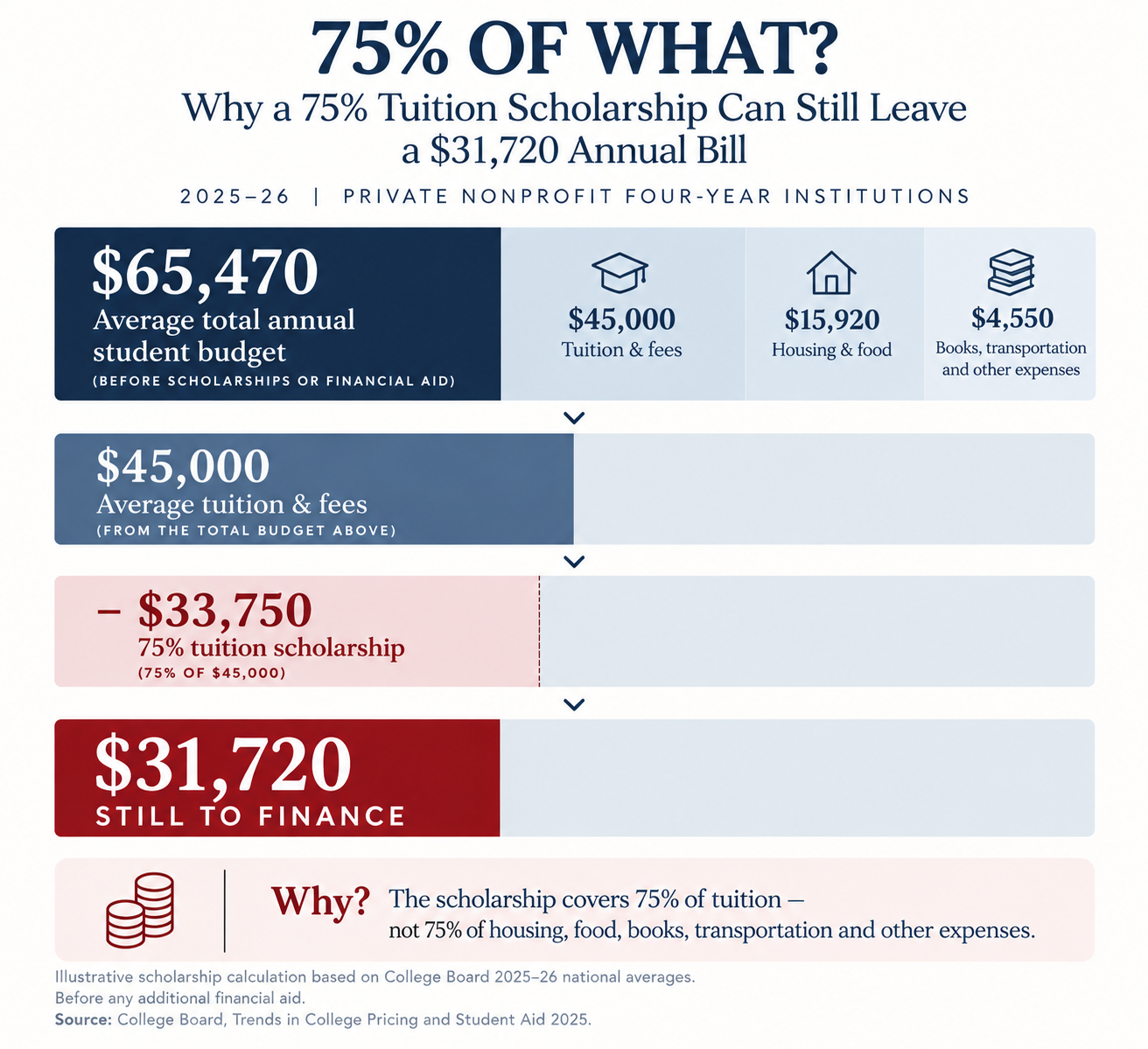
75% of what?
For 2025–26, College Board reports average tuition and fees of approximately $45,000 at private nonprofit four-year institutions in the United States. With housing and food, the average published figure rises to $60,920. Once books, transportation and other expenses are included, College Board estimates the total annual student budget at $65,470. These figures are before scholarships or financial aid.
Now consider a student receiving a scholarship covering 75% of tuition and fees. Applied to the $45,000 average tuition figure, the scholarship would be worth $33,750. As impressive as that sounds, approximately $31,720 of the average annual student budget would still remain to be financed, before any additional financial aid.
This is why the more useful figure is the remaining annual cost: what the student and family will actually need to finance each year.
The distinction becomes even more important at the upper end of the US market, where the published annual cost of attendance at some private universities is now around or above $100,000. Duke University, for example, estimates its 2026–27 cost of attendance for a first-year undergraduate at approximately $103,000 before financial aid.
A large scholarship can still be an excellent offer. The question is whether the remaining contribution is sustainable across the entire degree and within the family's wider financial commitments.
“I’ll work while I study”
Another common assumption is that any remaining financial gap can be covered through part-time work in the United States.
For students on an F-1 visa, employment is considerably more restricted. Qualifying on-campus employment is permitted and generally limited to 20 hours per week while classes are in session. Off-campus employment operates under different rules and requires an eligible basis and appropriate authorization. Economic-hardship employment, for example, is subject to specific conditions and is not simply an alternative source of income available on arrival. The US Immigration and Customs Enforcement guidance on F-1 employment sets out these restrictions.
Student employment can provide experience and useful supplementary income. It should not, however, be the mechanism that makes an otherwise unaffordable university affordable.
A useful financial stress test is:
Could your family still afford this university if the student earned nothing?
Full tuition, full ride and full demonstrated need
These terms describe fundamentally different forms of funding.
A full-tuition scholarship covers tuition but may leave substantial costs for housing, meals, insurance, travel and everyday life. A full ride or full-cost scholarship goes further, normally covering tuition together with major living and university costs.
Need-based financial aid follows a different logic. Some highly selective universities commit to meeting 100% of an admitted student's demonstrated financial need. Harvard College, for example, gives international students access to need-based financial aid on the same basis as US students, does not consider financial need in admission, and meets 100% of demonstrated need.
“Demonstrated” is important. Universities assess family income, assets and other financial circumstances to determine what they believe a family can contribute. That figure will not necessarily correspond exactly to what the family itself considers affordable.
There is also a crucial distinction between need-blind and need-aware admission. At a need-blind institution, requesting financial aid does not affect the admission decision. Brown University, for example, applies need-blind admission to first-year international applicants and meets 100% of demonstrated financial need.
At a need-aware university, the amount of financial assistance an international applicant requires may be considered during admission. Northwestern University is one example: it meets 100% of demonstrated need for admitted first-year international students receiving aid, while remaining need-aware for international applicants.
A university can therefore be exceptionally generous to the international students it admits while being exceptionally selective when considering applicants requiring substantial aid. That distinction is central to building a realistic university list.
For international applicants, academic context matters
International applicants arrive with school records and qualifications that may be more or less familiar to American admissions offices. This is particularly relevant for students applying from 11-year secondary-school systems, as remain common in parts of Central Asia.
English proficiency and standardized academic testing serve different purposes. IELTS or TOEFL may demonstrate readiness to study in English; an SAT or ACT result provides additional academic evidence.
For strong applicants from less familiar educational systems, I often recommend considering the SAT even where submission is optional. A strong result offers an internationally recognizable reference point alongside the transcript, GPA, school profile and curriculum.
It should not be overstated. An SAT result does not convert an 11-year education into a 12-year education or replace the school record. Its value lies in providing another piece of externally comparable evidence with which an admissions office can interpret the student's academic level.
Harvard's international-applicant policy illustrates the distinction clearly: Harvard requires standardized testing, normally through the SAT or ACT, while IELTS, TOEFL and Duolingo cannot substitute for that requirement.
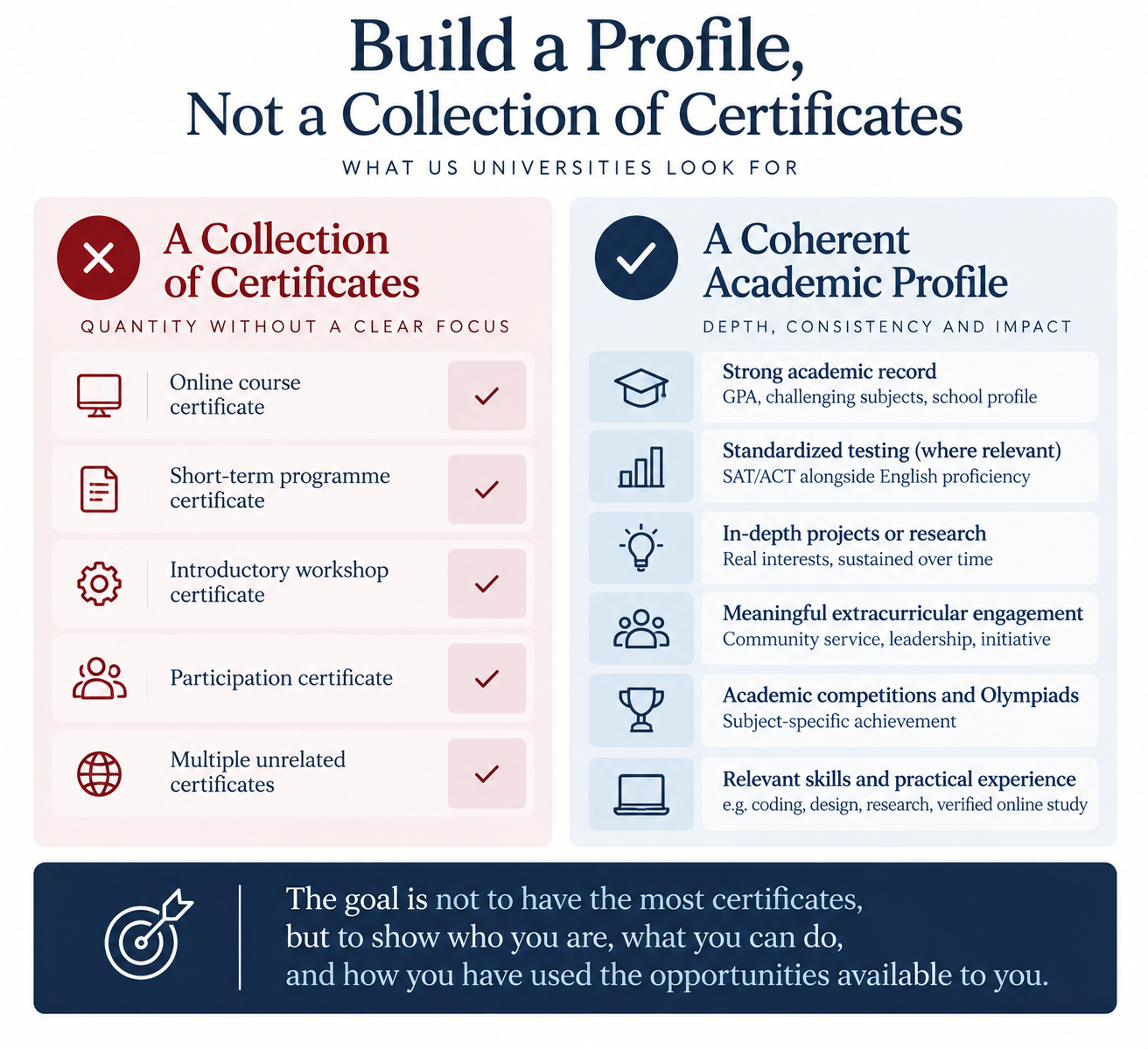
Build a profile, not a collection of certificates
Strong academic performance is fundamental when competing for admission and substantial funding at selective universities. But students sometimes mistake volume for substance outside the classroom.
Ten unrelated online certificates are not necessarily stronger than one demanding course pursued seriously. Five short activities selected because they might “look good for university” rarely communicate the same depth as sustained engagement with a genuine interest.
What matters is what the different elements of an application reveal when considered together.
A strong profile might combine academic performance and testing with research, technical or independent projects, sustained community involvement, leadership, artistic achievement or high-level sport. Verified tutoring through Schoolhouse.world, rigorous university-level online study, research programmes, Olympiads and academic competitions can all add value when they connect meaningfully to the student's wider development.
A computer science applicant who has pursued advanced study, built something useful, improved it over time and applied those skills to a genuine problem presents a coherent intellectual trajectory.
A folder containing twenty certificates tells me that the student has a folder containing twenty certificates.
The objective is not to manufacture a perfect applicant. It is to present credible evidence of who the student is, what they can do, what matters to them, and how they have used the opportunities available to them.
Be careful with Early Decision when funding is essential
International students are frequently told that applying Early Decision will improve their chances. That advice requires qualification.
Early Decision is binding: an admitted student is ordinarily expected to enroll and withdraw other applications. Brown University's Early Decision guidance explicitly cautions applicants against assuming that applying ED itself improves their chances of admission. Brown also uses the same methodology to determine eligibility for need-based financial aid under Early Decision and Regular Decision.
This does not mean that students requiring financial aid should never apply ED. If a family understands the university's financial-aid methodology and is comfortable with the commitment, it may be entirely appropriate.
But when complete or near-complete funding is essential, preserving the ability to evaluate several admission and funding outcomes can have considerable value.
An admission strategy and a financial strategy are not always the same thing.
Four funding models worth distinguishing
For international applicants requiring substantial financial support, I find it useful to organize US opportunities into four broad groups.
Need-blind + 100% demonstrated need
Financial need is not considered in admission, and demonstrated need is met for students who are admitted. These opportunities can be extraordinary, but they are concentrated among some of the world's most selective institutions.
Need-aware + 100% demonstrated need
Universities may still provide exceptionally generous packages, but the amount of aid required can influence admission. Northwestern is one example.
Merit-based full ride or full cost
These are highly competitive awards based primarily on exceptional achievement. Duke's Karsh International Scholars Program is a notable example for international students, covering tuition, room and board, mandatory fees, demonstrated need beyond those costs and funding for three summers of academic or professional opportunities.
Full tuition
These scholarships can transform the economics of an American education but still leave living and other costs to the student. Vanderbilt University, for example, offers major full-tuition merit scholarships for which international applicants can be considered.
These distinctions are considerably more useful than treating every award carrying the word “scholarship” as financially comparable.
Funding has to fit the wider university strategy
For international applicants seeking substantial financial support, the United States presents an unusual landscape. A university with a published annual cost approaching $100,000 may ultimately be more affordable for one student than an institution charging a fraction of that amount. For another student, precisely the opposite may be true.
The difference lies in the student's academic profile, the institution's funding model, the family's financial circumstances and the competitiveness of the relevant scholarship or admission route.
This is also why I would hesitate to build an entire university strategy around one country. For some students, the United States will offer an exceptional combination of academic opportunity and financial support. For others, universities in Europe, China, Hong Kong, South Korea or elsewhere may offer a stronger academic and financial proposition.
“I need a full scholarship” is not, by itself, a university strategy.
A good strategy starts with the student's academic profile and ambitions, establishes what the family can realistically sustain, and then identifies the universities and funding models in which those two realities can meet.
CAC USA Full-Funding Guide 2027
For students and families who want to move from these principles to individual universities, Coskun Academy Consulting has prepared the CAC USA Full-Funding Guide 2027 for International Undergraduate Applicants.
The guide organizes selected universities and scholarship opportunities into four categories:
Need-Blind + 100% Demonstrated Need · Need-Aware + 100% Demonstrated Need · Full Ride/Full Cost · Full Tuition
It also includes application and scholarship deadlines, testing policies, required application actions and our suggested SAT targets for competitive international applicants.
This article and the accompanying guide have been prepared for the 2027 undergraduate application cycle. Admission requirements, standardized-testing policies, financial-aid rules, scholarship terms and deadlines can change. Applicants should always confirm current information directly with the relevant university before submitting an application.
The financial examples used in this article are illustrative. Actual costs and financial-aid packages vary substantially by university, location and individual family circumstances.

Do you have a question or comment you would like to share with the author? Leave it below.